
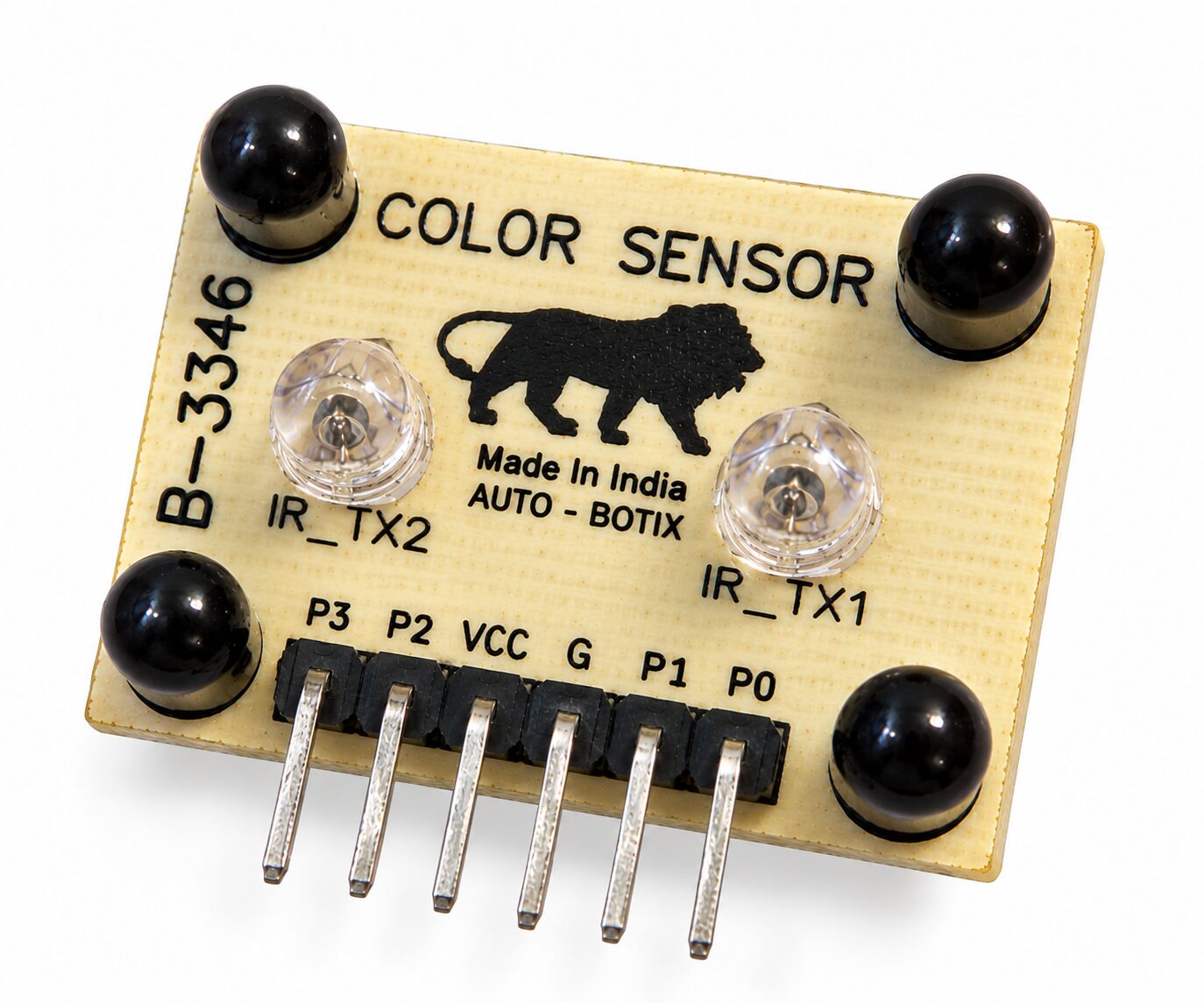
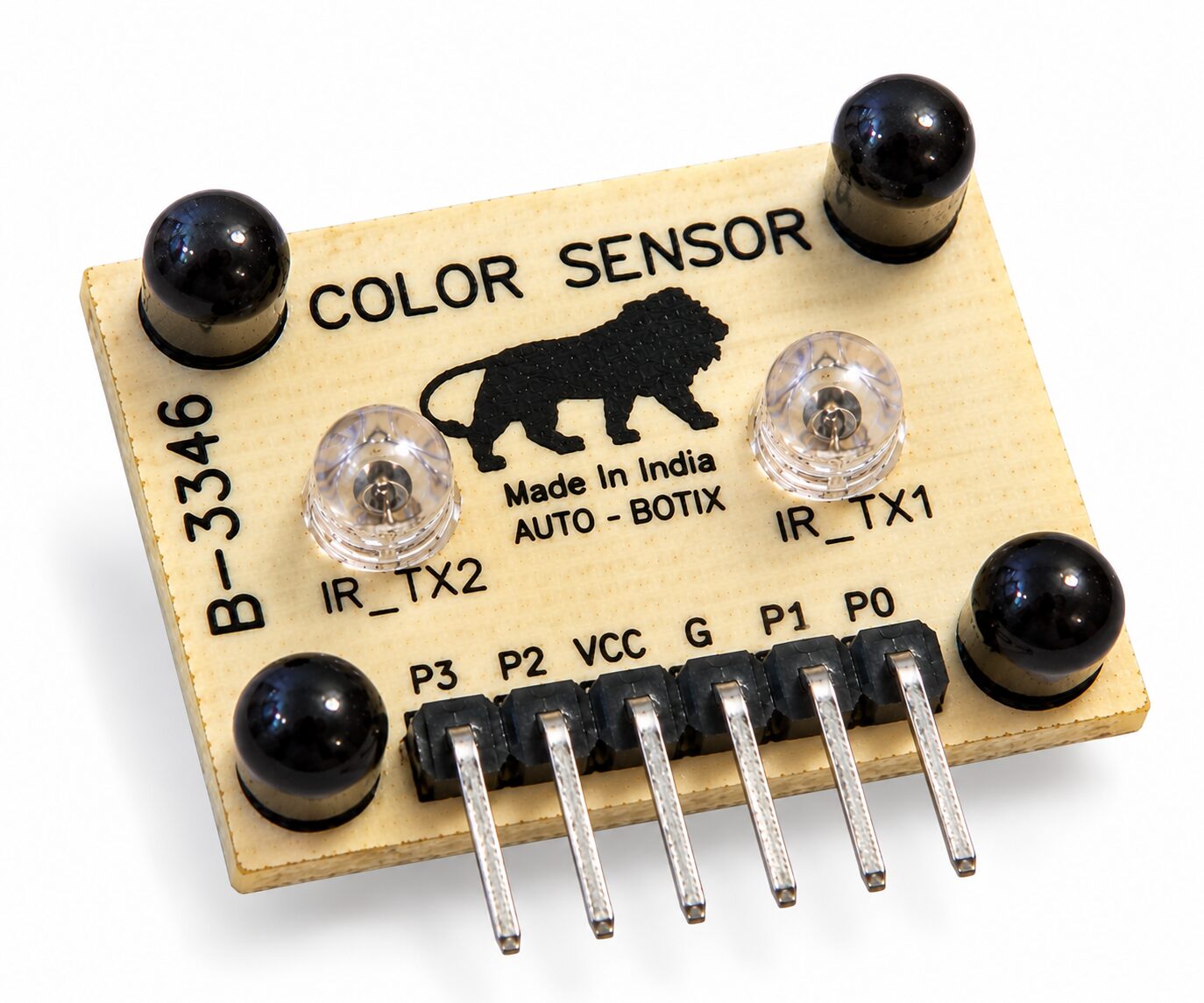
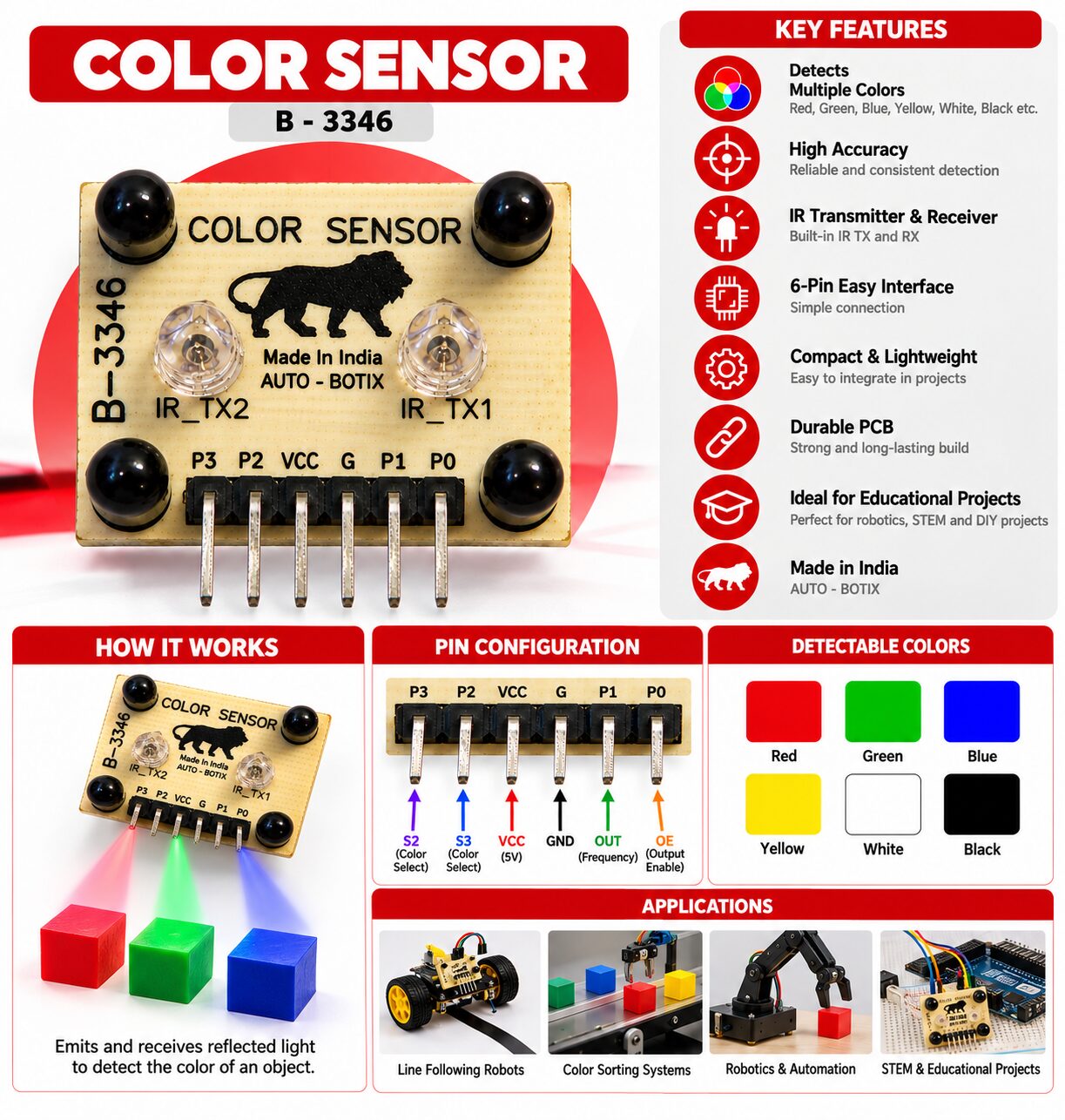
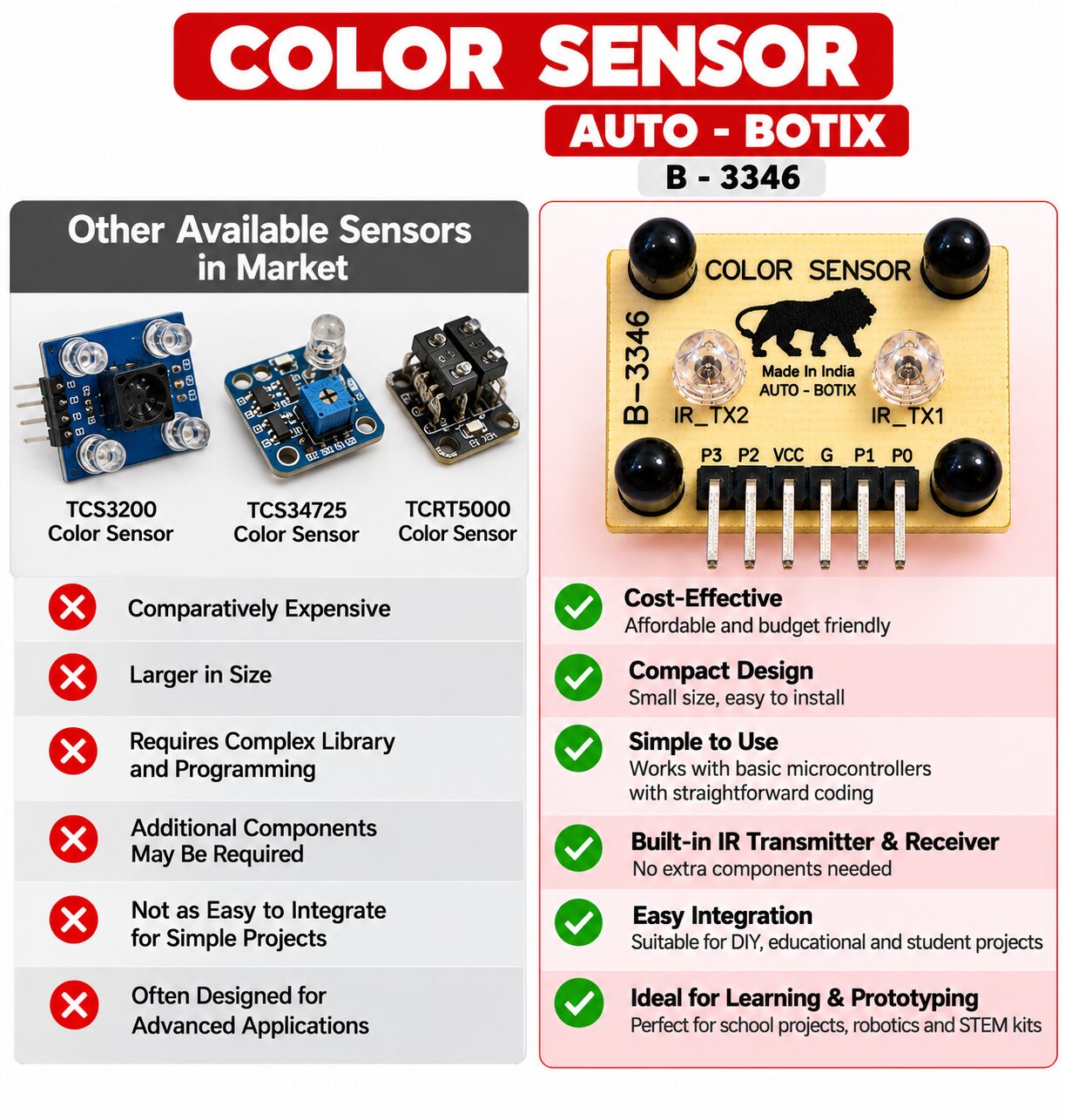
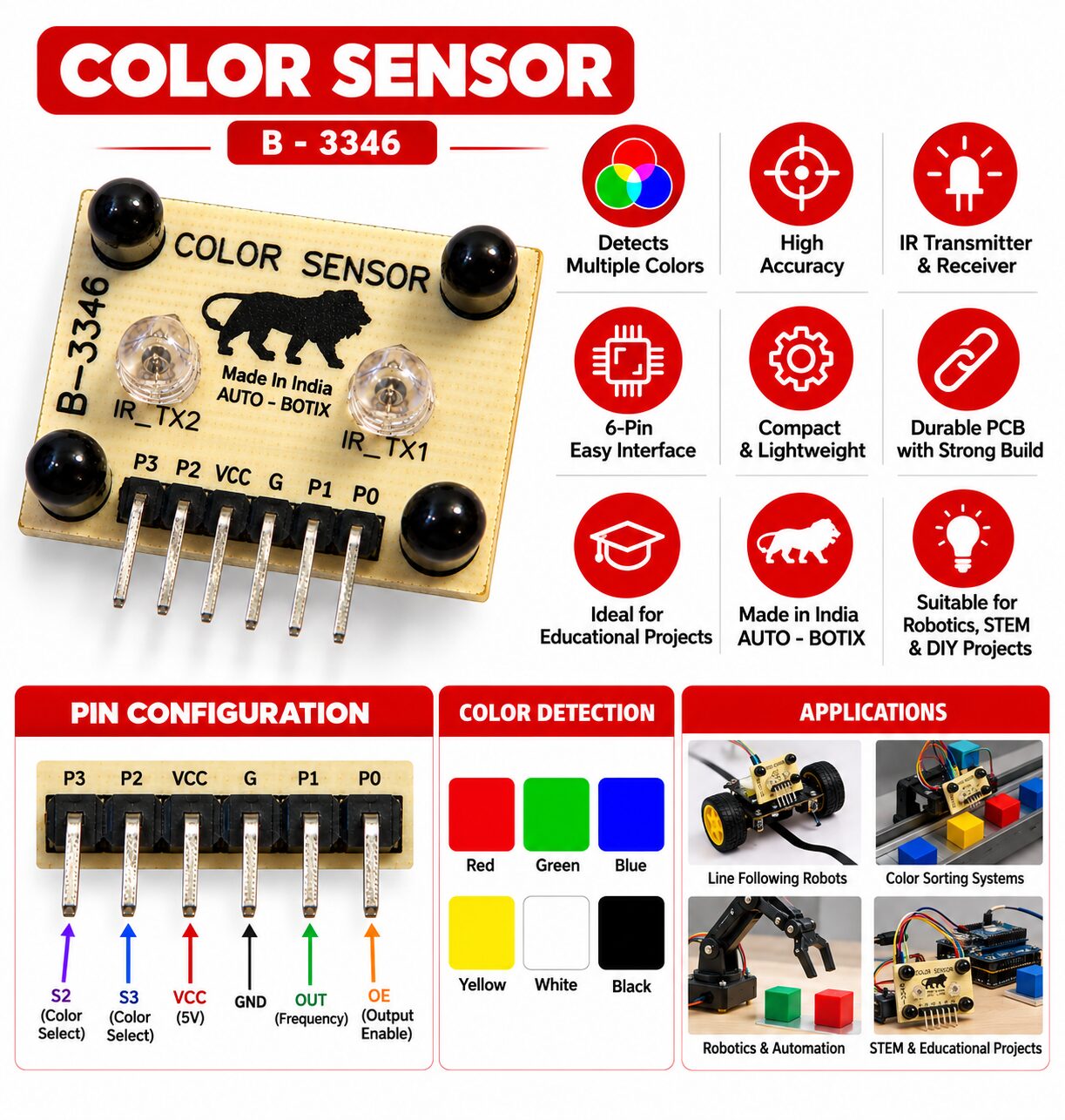
AUTO BOTIX B-3346 IR Based Color Sensor Module – Low Cost Reflective Sensor for Robotics & DIY Projects
SKU:Technical Specifications
| Specification | Details |
|---|---|
| Brand | AUTO BOTIX |
| Model | B-3346 |
| Product Type | IR-Based Reflective Color Sensor |
| Sensing Technology | Infrared Reflection |
| IR Component Size | 5mm |
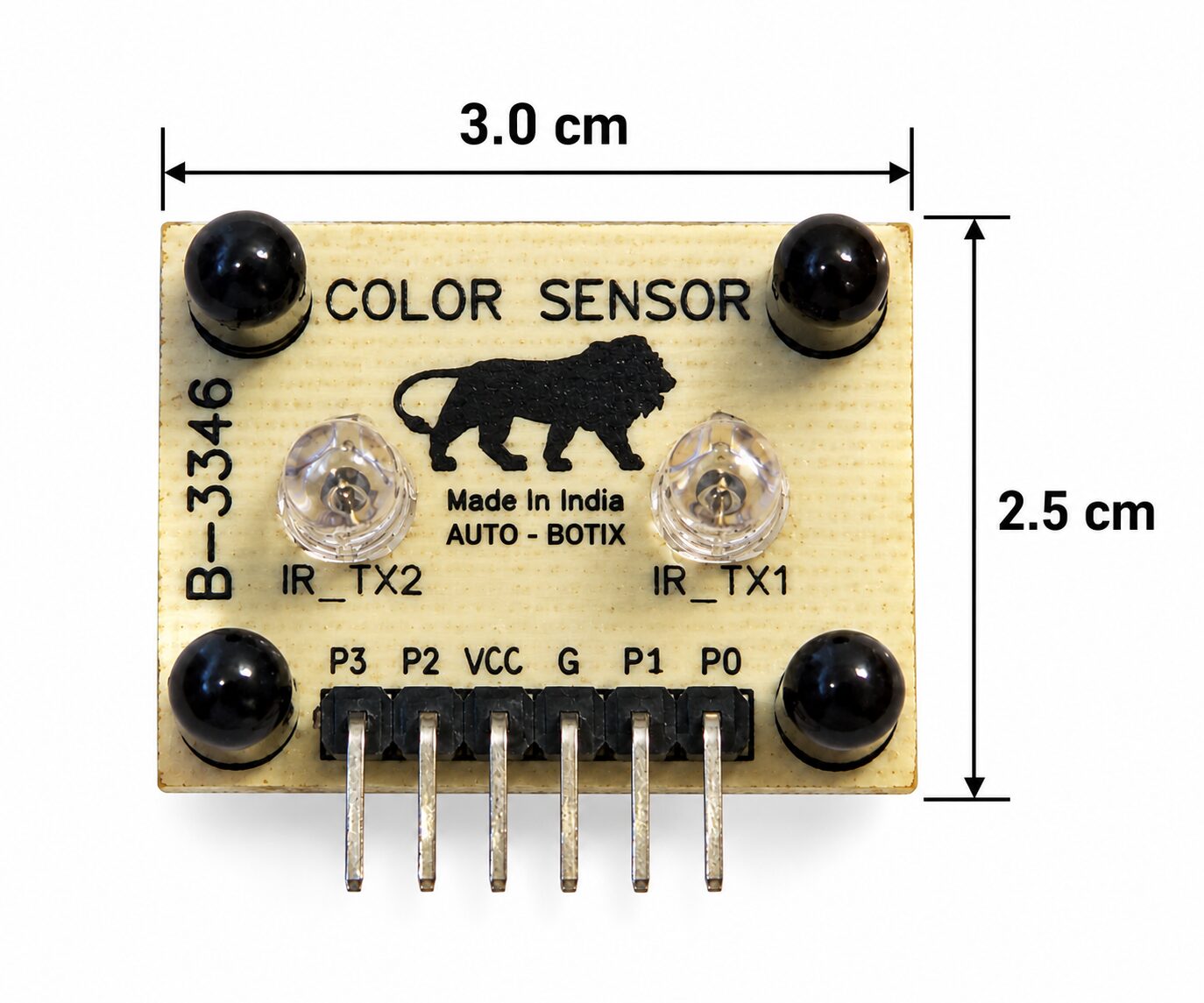
| PCB Dimensions | 30 × 25 mm |
| Interface | 6 Pins |
| Pin Labels | P3, P2, VCC, G, P1, P0 |
| PCB Color | Cream |
| Country of Origin | India |
₹65.00 ₹199.00

AUTO BOTIX B-3346 IR Based Color Sensor Module
Affordable IR-Based Sensing Technology for Robotics & Electronics Projects
The AUTO BOTIX B-3346 IR Based Color Sensor Module is a compact, economical sensing board designed and manufactured in India for students, hobbyists, electronics developers and robotics enthusiasts.
Unlike conventional RGB color sensors that use specialized color-sensing ICs, this module uses an infrared transmitter and receiver arrangement to detect variations in reflected IR light.
Its simple design makes it suitable for basic reflective sensing, educational color differentiation experiments and DIY electronics projects.
Key Features
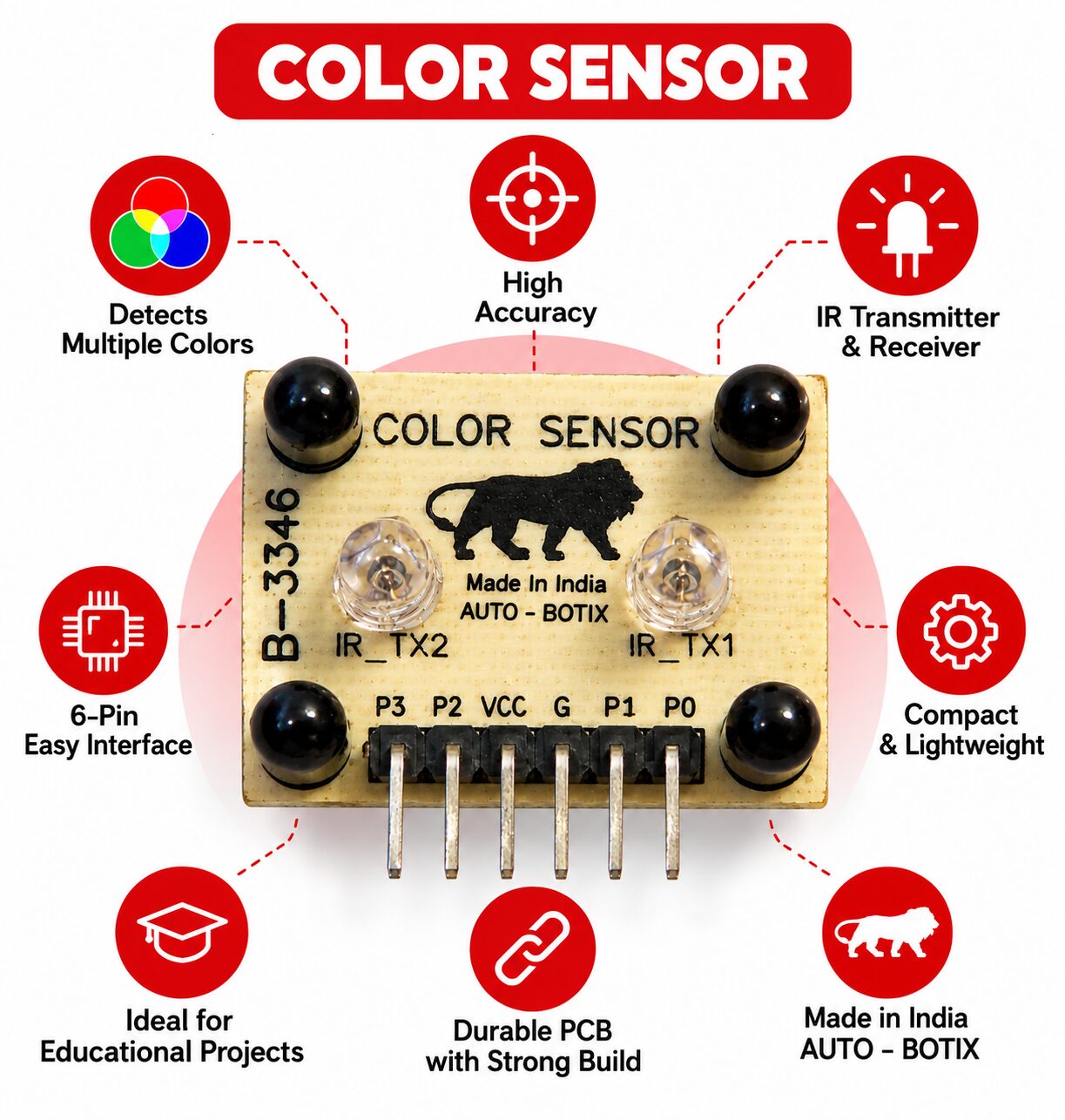
- Cost-Effective Design: Affordable option for educational and experimental sensing applications.
- IR-Based Technology: Uses infrared transmission and reflection for surface sensing.
- 5mm IR Components: Equipped with 5mm infrared transmitter and receiver components.
- Compact PCB: Measuring just 30 × 25 mm for integration into small electronic projects.
- 6-Pin Interface: Features P3, P2, VCC, G, P1 and P0 connections.
- Educational Applications: Suitable for robotics, STEM education and engineering experiments.
- Made in India: Manufactured under the AUTO BOTIX brand.
How Does It Work?
The sensor operates using infrared reflection technology.
- An infrared transmitter emits IR light toward a nearby surface.
- The surface reflects a portion of the infrared light.
- The IR receiver detects the reflected light.
- The received signal varies depending on surface reflectivity, distance and environmental conditions.
- With appropriate calibration and signal processing, the sensor can be used for basic surface differentiation experiments.
Note: This module is not a direct replacement for full RGB color sensors such as TCS3200 or TCS34725. Actual color differentiation depends on calibration and testing.
Applications
- Educational robotics projects
- Surface reflectivity experiments
- DIY electronics and sensor interfacing
- Engineering and science exhibitions
- STEM education and practical learning
- Embedded systems prototyping
- Experimental color differentiation
| Weight | 0.5 kg |
|---|---|
| Dimensions | 11 × 11 × 4 cm |
Related products
-
Biometric/ ECG/ EMG Sensors, Latest Product, New Arrival, Other Sensors, Sensor Kits, Sensor Mudules, Uncategorized
Heart Rate Monitor Kit with AD8232 ECG sensor module
-45% Biometric/ ECG/ EMG Sensors, Latest Product, New Arrival, Other Sensors, Sensor Kits, Sensor Mudules, Uncategorized
Heart Rate Monitor Kit with AD8232 ECG sensor module
- Designed to extract, amplify, and filter small biopotential signals.
- Leads-Off Detection.
- Shutdown Pin.
- LED Indicator.
- Analog Output.
- 3.5 mm Jack for Biomedical Pad Connection.
SKU: n/a -
Flame Sensor, New Arrival, Other Sensors, Sensor Mudules, Uncategorized
5-Channel Flame Sensor Module
-55% Flame Sensor, New Arrival, Other Sensors, Sensor Mudules, Uncategorized
5-Channel Flame Sensor Module
Quick Overview
- Detecting range: >120 degree
- Analog and digital outputs
- On-board potentiometer and indicators
- 1% resistors to make this module more reliable and precise
- Operating Voltage: 3.3V – 9V
- Board Diameter: 40 mm.
SKU: n/a -
Other Sensors
AutoBotix BMP280 Barometric Pressure and Altitude Sensor I2C/SPI Module
Quick Overview
- Operating Voltage: 1.71V to 3.6V would typically be operated from 3.3V.
- Operating Temperature: -40 to +85 deg. Celsius (full accuracy between 0 and +65 deg. C).
- Peak current: 1.12mA.
- Operating Pressure: 300 hPa to 1100 hPa.
- Accuracy between 700 to 900hPa and 25 to 40 deg. C : ±0.12hPa and ±1.0m.
SKU: n/a

